

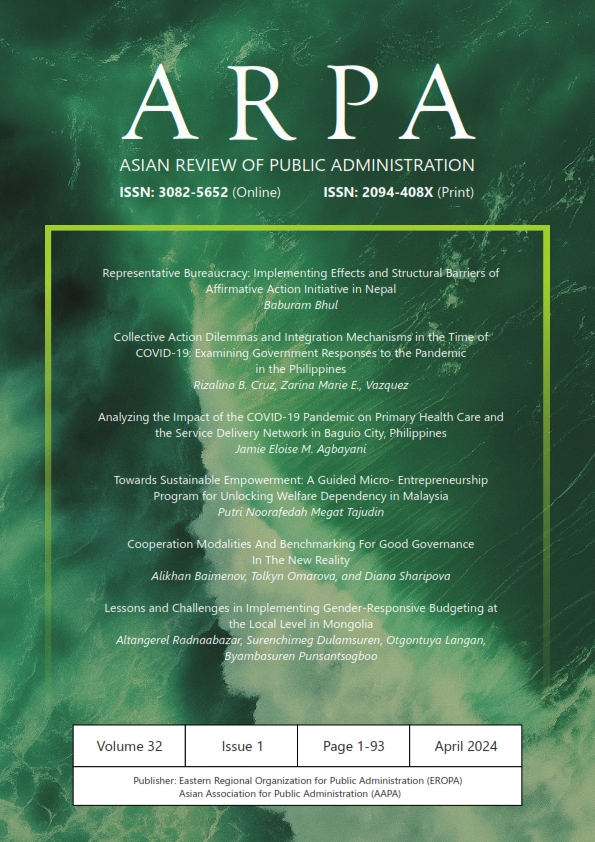
Lessons and Challenges in Implementing Gender-ResponsiveBudgeting at the Local Level in Mongolia
DOI:
https://doi.org/10.64423/arpa.v32i1.11Keywords:
Gender-Responsive Budgeting (GRB), public financial management, gender mainstreaming, Mongolia, local governance, capacity building, gender equalityAbstract
Gender-Responsive Budgeting (GRB) has emerged as a crucial policy instrument for promoting gender equity in public financial management. In Mongolia, despite relatively strong gender equality indicators, women remain underrepresented in leadership roles and continue to face structural barriers to accessing public services and economic opportunities. This article examines the lessons learned and challenges encountered in the local-level implementation of GRB in Mongolia from 2020 to 2023. Drawing on a pilot initiative supported by the MERIT project and implemented in four provinces—Dundgobi, Dornod, Sukhbaatar, and Tuv—the study analyzes the impact of capacity-building efforts, micro-projects, and intergovernmental collaboration on integrating gender perspectives into local governance and budgeting. Using qualitative analysis of training data, project implementation reports, and stakeholder reflections, the study identifies key enablers of GRB, such as gender-disaggregated data usage, institutional commitment, and civil servant engagement. However, it also highlights persistent challenges including limited analytical capacity, inadequate data systems, and policy fragmentation. The findings contribute to the broader discourse on public sector reform and gender mainstreaming by offering practical insights for scaling up GRB in decentralized governance contexts. The article concludes with policy recommendations to ensure the sustainability and institutionalization of GRB in Mongolia and similar transitioning economies.
References
Bosnic, M. (2015). Gender responsive budgeting. Professional Development Reading Pack No.14. GSDRC Applied Knowledge Services. April 2015. Retrieved from https://gsdrc.org/professional-dev/gender-responsive-budgeting/
Council of Europe. (2005). Gender Budgeting. Final report of the Group of specialists on gender budgeting (EG-S-GB). Equality Division. Directorate General of Human Rights. Strausborg. Retrieved from https://rm.coe.int/1680596143
Erdenechimeg, J., & Enkhtuvshin, A. (2004). Engendering Economic Transition: Gender-Sensitive Budgeting: Experiences from Mongolia and Implications for Transition Countries. United Nations Development Programme publication. Ulaanbaatar. Retrieved from http://www.undp.or.jp/ undpandjapan/widfund/doc/Mongolia%20UNDP%20GSB%20Manual.doc
Filion, M., & Langan, O. (2021). GRB Pilot in Dornod. Ulaanbaatar: MERIT.
Filion, M., Goforth, M., & Jamiyandagva, L. (2020). Gender-Responsive Budgeting Guide for Local Budget Users 2020. Mongolia: Enhancing Resource Management through institutional Transformation project knowledge portal. Ulaanbaatar. Retrieved from http://portal.merit.mn/ dataset/grb-guide2020/resource/f270c8d1-5e4e-4d98-bda9-148ab347df27
Gender Associations International Consulting GmbH. (2020). Gender-Responsive Budgeting in the Municipality of Ulaanbaatar City: A guide to include a gender perspective in budgeting processes at the local level. Energy Efficient Building Refurbishment in Mongolia Project. German Technical Cooperation Agency. November 2020.
Government of Mongolia. (2024). Law on Promotion of Gender Equality, Cross-Sectoral Strategic Plan for Promoting Gender Equality in Mongolia (2022-2031). Retrieved from https://www.ncge.gov.mn/wpontent/uploads/2024/
Government of Mongolia. (2024). Mongolian Sustainable Development Goals’ Indicators Dashboard. Last readiness assessment made in December 2019. Retrieved from http://sdg.gov.mn/Home/ Availability
Government of Mongolia. (2023). Report on Implementation and Results of Activities to Promote Gender Equality. Retrieved from https://www.ncge.gov.mn/reports
Jamiyandagva, L. (2021). Gender Responsive Budgeting (GRB) in Mongolia: Experience and ways forward. International Gender Studies at the GRÓ Gender Equality Studies and Training Programme. Reykjavík, Iceland. Retrieved from https://www.grocentre.is/static/gro/ publication/786/ document/Lkhagvadulam%20Jamiyandagva_2021.pdf
International Bank for Reconstruction and Development & World Bank. (2021). Public Expenditure and Financial Accountability (PEFA) Mongolia: Performance Assessment Report 2021. World Bank, Washington DC. Retrieved from https://www.pefa.org/assessments/summary/ 5006
Lahousen, V., & Vandangombo, D. (2020). Capacity assessment – Gender responsive budgeting in Mongolia. June 2020. Gender Associations International Consulting GmbH. German Technical Cooperation Agency. Ulaanbaatar
MERIT (2024). Metamorphosis through MERIT: Outcomes and Impact of Mongolia: Enhancing Resource Management through Institutional Transformation (MERIT) 2016-2024. Retrieved from https://www.catalysteplus.org/wp-content/uploads/2024/02/Metamorphosis-through-MERIT-1.pdf
MERIT (2024). Gender-Responsive Budgeting at Local Level Modeling Program (Sub-Project) Report. Retrived from http://portal.merit.mn/en/dataset/grb-report/resource/d32a8221-6fd4-4602-96e7-3db33dfcae0f
MERIT (2024). Summary of the Report on Gender Responsive Budgeting Pilot Project. Retrived from http://portal.merit.mn/en/dataset/grb-report/resource/59e308d0-a970-4325-8aa1-da79de0a3fb5?view_id=aca9e9c9-bf66-450d-b95f-9fca9a7fce4e
Ministry of Finance (2024). Gender-Responsive Planning and Budgeting in Mongolia: Lessons learned and the next steps. Policy Brief. Retrieved from https://mof.gov.mn/article/entry/2024-02-00
Ministry of Finance. (2018). Gender Strategy for Organizations and Agencies under the Authority of the Minister of Finance of Mongolia (2016-2024). Translation. NCGE. Retrieved from https://ncge.gov.mn/publications
Ministry of Finance. (2021, October 11). Public Expenditure and Financial Accountability Assessment (Series 1). Retrieved from https://mof.gov.mn/article/entry/i
National Academy of Governance. (2024). Gender Responsive Budgeting online training. Ulaanbaatar. Retrieved from https://training-mongolia.thinkific.com/courses/grb
National Committee on Gender Equality & Mongolian Marketing Consulting Group. (2021). Evaluation of the Implementation of the Law of Mongolia on Promotion of Gender Equality. Summary report. NCGE/202001025. Retrieved from https://ncge.gov.mn/publications
National Committee on Gender Equality & United Nations Population Fund. (2014). Gender- Responsive Budgeting Training Manual. Publication. Retrieved from https://ncge.gov.mn/publications?page=3
National Committee on Gender Equality. (2020). Mongolia Gender Equality Status (up to date). Publication. Retrieved from https://ncge.gov.mn/publications
National Committee on Gender Equality. (2021, November 11). Twelve ministries are implementing its sectoral gender-responsive policies. Retrieved from https://ncge.gov.mn/news-detail/551
OECD (2013). Gender Equality in Education, Employment and Entrepreneurship: Final Report to the MCM 2012. OECD Publishing. Retrieved from https://www.oecd.org/en/publications/2017/07/2013-oecd-recommendation-of-the-council-on-gender-equality-in-education- employment-and-entrepreneurship_g1g7e32f.html
Parliament of Mongolia (2011). Law on Promoting Gender Equality. Ulaanbaatar. Retrieved from https://legalinfo.mn/mn/detail/253
Public Expenditure and Financial Accountability. (2020). GRPFM framework: Supplementary Framework for Assessing Gender Responsive Public Financial Management. Guidance for Assessment Teams, PEFA Secretariat, Washington, DC, January 2020. Retrieved from https://www.pefa.org/gender
Schneider, K. (2006). Manual for Training on Gender Responsive Budgeting. Prepared for GTZ. https://www.ndi.org/sites/default/files/Manual%20for%20Training%20on%20Gender%20Responsive%20Budgeting.pdf
Sharp, R. (2003). Budgeting for Equity: Gender Budget Initiatives within a Framework of Performance- Oriented Budgeting. New York: United Nations Development Fund for Women (UNIFEM). Retrieved from https://www.unwomen.org/sites/default/files/Headquarters/Media/Publications/ UNIFEM/BudgetingForEquity1stHalf.pdf
Stotsky, J. G. (2016). Gender Budgeting: Fiscal Context and Current Outcomes. IMF Working Paper WP/16/149. Research Department and Strategy, Policy, and Review Department. International Monetary Fund. Retrieved from https://www.imf.org/external/pubs/ft/wp/2016/wp16149.pdf
Vladisavljevic, A. (2021). Implementation of the GRB Action Plan, next steps in 2021. Presentation for the 2nd meeting of the GRB Working Group. March 10, 2021. Ulaanbaatar
Downloads
Submitted
Accepted
Published
Issue
Section
License
Copyright (c) 2024 Altangerel Radnaabazar, Surenchimeg Dulamsuren , Otgontuya Langan, Byambasuren Punsantsogboo

This work is licensed under a Creative Commons Attribution-NonCommercial 4.0 International License.





 This work is licensed under a